America has lost a true hero: Dick Winters dead at 92
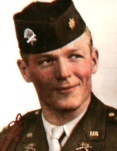 Last week America lost one of her true heroes when Dick Winters died at the age of 92. I first learned of this great man’s death while visiting Conservative Hideout and reading the tribute that Matt posted there, and I have been saddened by the loss of a man who I never knew because we are losing so many of this generation, soon they will be gone but the liberty they secured for us will be the lasting tribute to these men.
Anyone who has seen the brilliant portrayal of Easy Company in the Tom Hanks/Steven Spielberg/HBO mini-series “Band of Brothers” knows exactly who this man is. Dick Williams was a soldier of the 506th Regiment, 101st Airborne on D-Day, before assuming command of the company when Easy Company’s leader was killed on D-Day. He led Easy Company all the way from D-Day and into the Battle of the Bulge, where he and his company somehow managed to hold Bastogne and end the last Nazi offensive of WWII, ensuring an Allied victory.
His heroics are well documented in the mini-series, and I can not do this man the justice he deserves so instead I will post his obituary here for all to read:
Richard “Dick” Winters, the Easy Company commander whose World War II exploits were made famous by the book and television miniseries “Band of Brothers,” died last week in central Pennsylvania. He was 92.
Winters died following a several-year battle with Parkinson’s Disease, longtime family friend William Jackson said Monday.
An intensely private and humble man, Winters had asked that news of his death be withheld until after his funeral, Jackson said. Winters lived in Hershey, Pa., but died in suburban Palmyra.
The men Winters led expressed their admiration for their company commander after learning of his death.
William Guarnere, 88, said what he remembers about Winters was “great leadership.”
“When he said ‘Let’s go,’ he was right in the front,” Guarnere, who was called “Wild Bill” by his comrades, said Sunday night from his South Philadelphia home. “He was never in the back. A leader personified.”
An other member of the unit living in Philadelphia, Edward Heffron, 87, said thinking about Winters brought a tear to his eye.
“He was one hell of a guy, one of the greatest soldiers I was ever under,” said Heffron, who had the nickname “Babe” in the company. “He was a wonderful officer, a wonderful leader. He had what you needed, guts and brains. He took care of his men, that’s very important.”
Winters was born Jan. 21, 1918 and studied economics at Franklin & Marshall College before enlisting, according to a biography on the Penn State website.
Winters became the leader of Company E, 506th Regiment, 101st Airborne Division on D-Day, after the death of the company commander during the invasion of Normandy.
During that invasion, Winters led 13 of his men in destroying an enemy battery and obtained a detailed map of German defenses along Utah Beach. In September 1944, he led 20 men in a successful attack on a German force of 200 soldiers. Occupying the Bastogne area of Belgium at the time of the Battle of the Bulge, he and his men held their place until the Third Army broke through enemy lines, and Winters shortly afterward was promoted to major.
After returning home, Winters married his wife, Ethel, in May 1948, and trained infantry and Army Ranger units at Fort Dix during the Korean War. He started a company selling livestock feed to farmers, and he and his family eventually settled in a farmhouse in Hershey, Pa., where he retired.
Historian Stephen Ambrose interviewed Winters for the 1992 book “Band of Brothers,” upon which the HBO miniseries that started airing in September 2001 was based. Winters himself published a memoir in 2006 entitled “Beyond Band of Brothers.”
Two years ago, an exhibit devoted to Winters was dedicated at the Hershey-Derry Township Historical Society. Winters, in frail health in later years, has also been the subject of a campaign to raise money to erect a monument in his honor near the beaches of Normandy.
Winters talked about his view of leadership for an August 2004 article in American History Magazine:
“If you can,” he wrote, “find that peace within yourself, that peace and quiet and confidence that you can pass on to others, so that they know that you are honest and you are fair and will help them, no matter what, when the chips are down.”
When people asked whether he was a hero, he echoed the words of his World War II buddy, Mike Ranney: “No, but I served in a company of heroes.”
“He was a good man, a very good man,” Guarnere said. “I would follow him to hell and back. So would the men from E Company.”
I think the sentence that sums up this great man the best is this:
When people asked whether he was a hero, he echoed the words of his World War II buddy, Mike Ranney: “No, but I served in a company of heroes.”
Included in Dick Winters’s will was a provision that the American people not be notified of his death until after the funeral; even in death he wanted to go out the way he lived, with no fanfare. Dick Winters epitomizes the “greatest generation,” they were not seeking glory, they had a job to do and they did it. That job just happened to be the protection of America and the free world and while Dick Williams denied it, this makes him a hero.
Rest in peace Dick Winters, I know you are in heaven because you have already been through hell.




 America's Watchtower
Great tribute Steve, and thanks for the link.
LikeLike
Thank you and you are welcome!
LikeLike