This day in history: General Lee surrenders at Appomattox in 1865
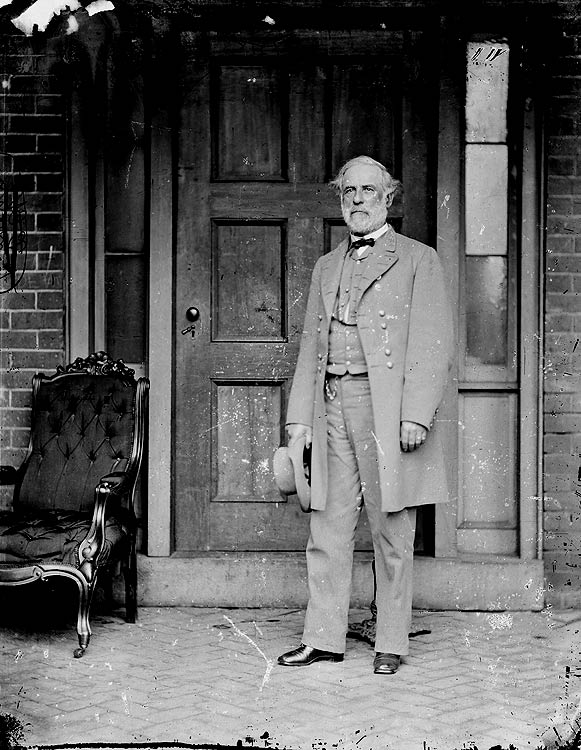 April 9th, 1865: General Lee surrenders to General Grant at Appomattox Court House, and although fighting and skirmishes were to continue in the west, the Civil War–or as my southern readers would prefer, the war between the states, or better yet, the war of northern aggression–was all but over.
But the story of Appomattox began on July 3th of 1863 with the conclusion of the battle of Gettysburg–a bloody three day battle that most historians believe was the turning point in the war. While many credit Gettysburg as the beginning of the end of the confederacy, President Lincoln was distraught when newly appointed General Meade failed to pursue General Lee and let him escape. President Lincoln felt that Meade had the chance to crush the rebellion and end the war but he failed to do so and his delay likely prolonged the war another two years.
Because of Meade’s inaction following Gettysburg, President Lincoln once again believed that the Union generals simply were not up to the task so he looked towards a general in the west who seemed to be the aggressive warrior that he had been looking for for several years. The Army of the Potomac had seen several generals who simply did not seem to have the wherewithal to stand up to General Lee–from McClellan to Meade–who seemed all too willing to try to out maneuver General Lee rather than deliver a knock out blow to him on the field.
And they were not without good reason to fear General Lee–he had never lost a battle until Gettysburg and he constantly out foxed the Union generals despite the north having the advantage of industry and numerical superiority. In my opinion General Lee is still one of the finest generals in history and he was thought of so fondly that at the outbreak of hostilities President Lincoln offered him overall command of the whole northern army. In an age when people still thought of their state as their true country, General Lee turned down the position in order to defend what he thought of as his country–Virginia.
Enter General Grant to the story; while General Meade was still the commanding general of the Army of the Potomac President Lincoln named General Grant as the General in Chief. While he and Meade worked together on the battlefield it was now General Grant who had the final say on all matters militarily.
I believe that while Gettysburg may have been the turning point of the war, it wasn’t until the battle of the Wilderness with General Grant in charge that the war effort really began to turn in the favor of the north. In the aftermath of a battle that was considered a draw the union soldiers were prepared to head north again as they always had after a battle, but were stunned to find out that General Grant was preparing to move south on General Lee and attack him wherever he was encountered. A large cheer went through the army when they realized they were going to remain on the offensive.
What set General Grant apart from the previous generals in the Army of the Potomac was the fact that the body counts simply didn’t seem to matter to him. He felt he had the numbers and could afford to lose many men because General Lee could not afford to lose men. General Lee attempted to use what he saw as General Grant’s aggression against him–feeling as if the northern people would become appalled at the rising death toll and would turn against President Lincoln and the war in general. All he had to do was hold on long enough and he felt the south would be able to sue for peace, and it almost worked.
General Grant and General Sheridan chased General Lee all they way back to the capital of Virginia–Richmond–where, much to his chagrin, he was forced into a siege of Richmond rather than an all out attack on the city. With his supply lines cut off General Lee held off as long as he could but after many months General Grant was able to break through the fortifications, but General Lee and his army managed to escape.
General Grant pursued General Lee until he was finally able to trap him in Appomattox Court House. General Lee’s troops did not want the general to surrender–preferring to disband and fight a guerilla war for as long as it took, but General Lee knew that the fight was over and that the time for reconciliation was at hand. He refused to fight any longer because it would be detrimental to the rebuilding process which he now knew must take place.
The darkest days in American history ended on this day in 1865 and after four long years of war reconciliation began.





Your post reminded me of a story I read in Carl Sandburg’s Lincoln. The President was taking a walk one morning and was on a hillside that overlooked the encampment of the Army of the Potomac, which was under the command of General McClellan. He pointed out the Army and asked his secretary if he knew what it was. The secretary dutifully replied that it was the Army of the Potomac, to which President Lincoln replied that it was not, but was rather McClellan’s bodyguard.
LikeLike
A great story indeed! I am going to have to put that book on my “to read” list. The Civil War is one of my favorite subjects.
LikeLike
Enjoyed reading your post. Touring Antitam was a very moving experience – such horrific sacrifices made by both Union & Confederate soldiers.
LikeLike
Thank you, the family and I are going on a trip next weekend to Gettysburg and I can’t wait to see this historic location.
LikeLike
LOL! My hubs says he can never forget my birthday b/c it’s the day Lee surrendered.
cheers
LikeLike
That is a strange way to remember your birthday, but as long as it works….. 🙂 Happy Birthday!
LikeLike
When the Civil War documentary was put again on TV I looked for interviews with Civil War veterans and was shocked to not find more than 1 or 2 of them. Maybe interviewing for history’s sake wasn’t popular then?
LikeLike
I watched part of the Civil War documentary today, it was on PBS. I think most of veterans did not conduct formal interviews, but they left their feelings in the diaries and journals that many of them kept.
LikeLike
I guess this must be the reason. I read about two big reunions held at Gettysburg but could find few interviews. Maybe they just didn’t like speaking about it.
LikeLike
A great post, Steve. Thank you for writing it.
LikeLike
Thank you for the compliment!
LikeLike
Loved this post, Steve. My family has an encyclopedia of Mathew Brady’s Civil War photos. Terribly interesting history.
LikeLike
Thanks! The Civil War photos that he took are amazing and really drives home the brutality of this war. I am going to have to see if I can find that encyclopedia.
LikeLike
Hey Steve, hope you guys had a great trip!
Here is the information I was referring to ====>
The books are called: Photographic History of the Civil War, in 10 Volumes, dated 1911. The Editor-in-Chief was Francis Miller, and it was compiled/written by “The Review of Reviews Co.” The publisher was the Patriot Publishing Company, of Springfield Mass. But is also says The Trow Press, New York. Spectacular stuff.
LikeLike