This day in history: Pickett’s Charge
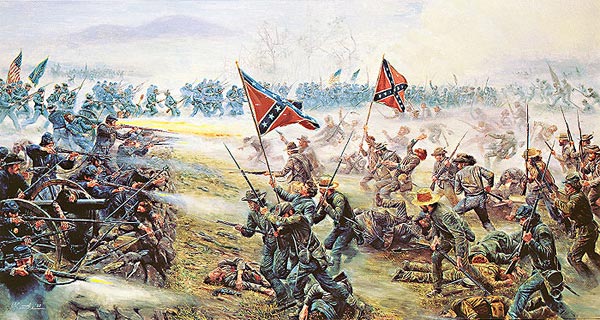 The date was July 3rd, 1863: The Civil War had reached the north when General Lee decided to travel along the Blue Ridge Mountains and surprise the Federals with a decisive battle which he felt would clear the road to Washington and force the north to sue for a peace which would include southern independence, and in all likelihood a victory here would have achieved those results. His moves were discovered, the Federals advanced on his position, and both armies converged at the small town of Gettysburg. General Lee did not want to fight here, it was not of his choosing, but the enemy was here and he would not retreat at this point so fight them he did.
The first two intense and bloody days of battle had ended with the north holding the high ground at both Culp’s Hill and Little Round Top–positions they held when the battle began. Having failed at flanking the north on both the left and the right (due in large part to a heroic bayonet charge ordered by General Chamberlain after his men had exhausted all of their ammunition) General Lee decided that on the morning of July 3rd, he would attempt a bold attack on the Union center which has gone down in history as “Pickett’s charge.”
The battle began with a fierce artillery and cannon barrage on the Union’s positions on top of Cemetery Ridge, but the cannon overshot and was ineffective. Suddenly in mid-afternoon out of the trees below Cemetery Ridge emerged a line one mile long which began to march a distance of one mile toward the federal position–Pickett’s charge had begun. As soon as the men emerged from the trees they were within artillery range and the Union opened fire, yet the Confederates kept on coming despite the already rising death toll until they reached Emmitsburg road.
Emmitsburg road was about halfway between the Confederate starting point and the Federal position and it proved to be a huge obstacle to the Confederate advance. There was a fence on both sides of the road and as the Confederates attempted to scale both fences they came under fire from the Union for they were now within range of rifle fire. As the bodies piled up at the fences the soldiers climbed over them and the Confederates kept moving forward as the fate of the country hung in the balance. Nothing could stop them.
Against all odds the Confederate Army reached and broke the Federal line, all hope looked lost to the Federals as it appeared the Confederates would march straight to Washington. But Pickett’s charge was a two pronged attack: Once General Pickett’s men reached the federal position he was supposed to have been met by the cavalry of General Jeb Stuart, who was supposed to ride around the enemy’s rear and form a pincer movement which would have split the Union army in half atop Cemetery Ridge.
But General Stuart never made it to the rear of the Union army and was never able to reinforce the charge because he was met by a small band of Union cavalry, led by a little known newly appointed general who was eager to make a name for himself. General Stuart thought that this small band of cavalry was not serious in attacking his much larger force, but they were and they did. The Union cavalry was able to hold off the Confederate advance until reinforcements showed up, when they did General Stuart was forced to withdraw and General Pickett’s men were on their own on top of the hill.
This general was a hero at Gettysburg, but he never received the glory that he had hoped for his contribution, he would have to wait until 1876 at the Battle of Little Bighorn for his name to go down in history–his name was General George Custer.
 Without General Stuart’s reinforcements the Confederates could not sustain the momentum after this momentous charge; the Union army regrouped and pushed the Confederates back down the ridge. At a combined cost of 50,000 lives, the battle of Gettysburg was over and the union was saved, ironically, it was on the Fourth of July that General Lee ordered his men to retreat back toward Virginia.
This was the turning point in the Civil War, while there were still many battles to be fought before the contest was decided, never again did the Confederate army invade the north.




 America's Watchtower
Good Morning and thanks for the holiday weekend history lesson. It’s amazing how many Americans lost their lives – some trying to split the country, some trying to save the country.
LikeLike
The Civil War is an interesting study, I can’t get enough of it. It is amazing to think that we had an army prepared to march on Washington and take out the president.
LikeLike
This is easily the most optimistic interpretation of Pickett’s Charge I’ve ever read! I’ve never heard anyone else suggest that if Stuart’s cavalry had gotten through, the rebels would most likely have won the battle. I think the far more decisive element was the failure of the Confederate artillery to hit their targets consistently.
Just for the record, though, while total casualties of the Battle of Gettysburg are estimated in the range of 46,000 – 51,000, the death toll was under 8,000. The casualties include over 27,000 wounded and 11,000 captured/missing.
Take good care, and may God bless us all . . .
and Happy Independence Day!
TGY
LikeLike
I have tried to become a student of history over the last three years, and one of my favorite subjects is the Civil War, it is unbelievably interesting. The battle of Gettysburg, from all that I have read, is a battle that could have gone either way, yet every close call went to the Union. Lee told Longstreet to take Culp’s Hill on the first day of battle if practicable. Longstreet’s men had marched all day and were tired, he did not feel it was practicable so he did not take the hill. Culp’s Hill was not defended on the first day and the Confederates would have held the high ground if Longstreet had obeyed Lee’s command.
And then there was Chamberlain defending Little Round Top after he had run out of ammunition, this was another chance for the Confederates to win the battle, yet thet failed.
While Pickett’s charge has gone down in the annuls of history as an abject failure, the fact remains that his men did break through the Union line and the Federals were in disarray until they were finally regrouped. I am of the opinion that if Stuart’s cavalry made it to Cemetery ridge the Federals would not have been able to regroup–they would have been split in half and would not have recovered. I do agree that the misfiring of the cannon were a big part in the failure of the Confederates to win this battle, but Pickett and the Confederates had good battle plans and almost pulled it off. This was not the rout that many people think it is.
Of course, after almost 150 years of history all things are open to interpretation, but that is how I see the battle of Gettysburg.
LikeLike
It’s one of the quirks of history that Lee was a great general– for as long as he was defending Virginia. He could squeeze a victory out of impossible odds– in Virginia– but seemed to loose heart when he left Virginia territory. Getting Longstreet to obey his command to take Culp’s Hill is an example… there would have been no question but to obey Lee in his own territory, but his officers could tell he was somehow off his game outside.
The simple fact was that Lee didn’t believe in the causes of the Civil War, but would not fight against Virginia, so he was on that side.
Interesting topic, that war.
LikeLike
Good points, Lee basically performed miracles on the battlefield while outnumbered on many occasions, perhaps because he was not on his “home field” and didn’t know the ground as well as he did Virginia he wasn’t able to pull it off.
LikeLike
Happy 4th to you all! 🙂
LikeLike
And to you as well!
LikeLike